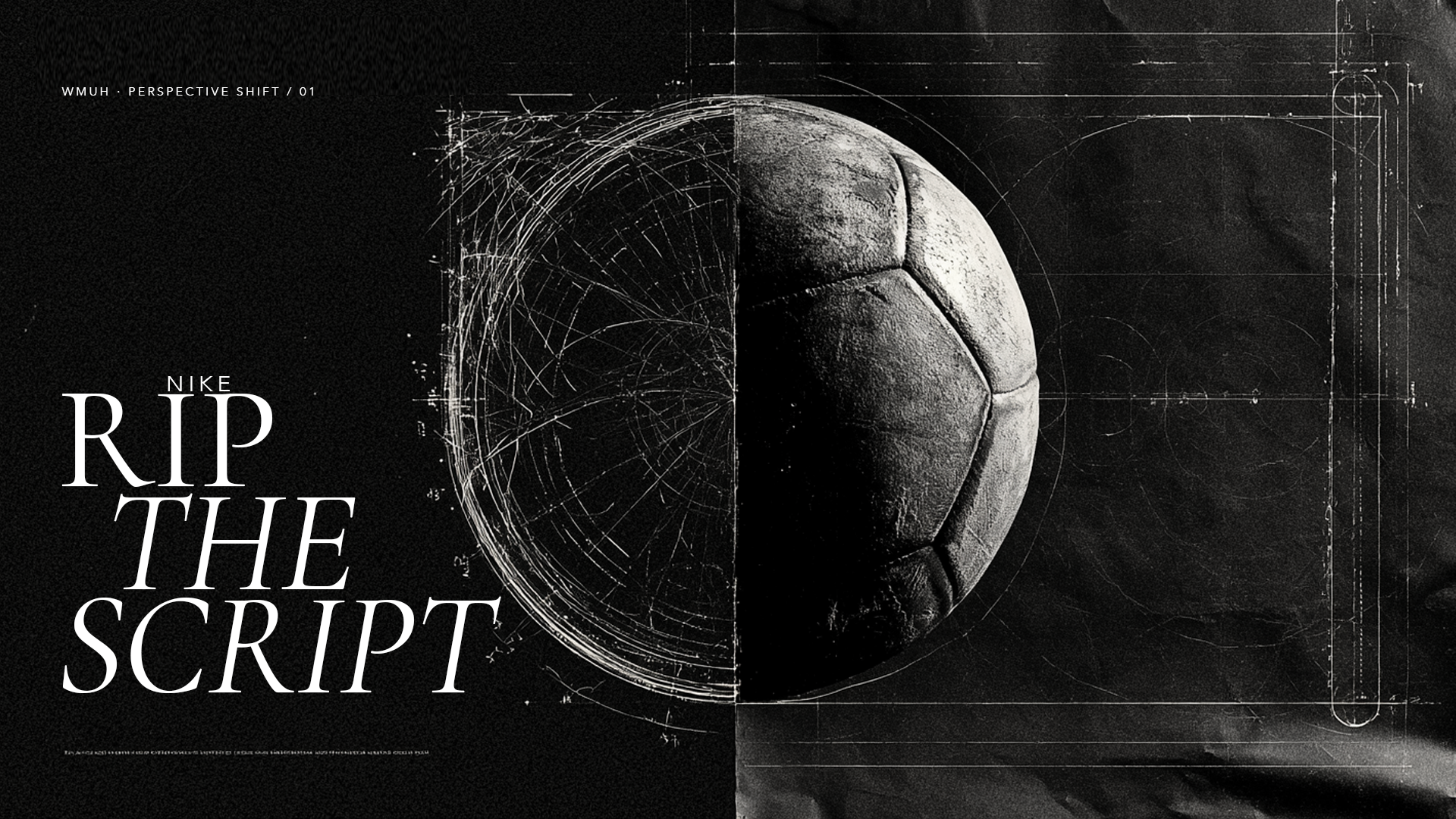
Nike built a culture powerful enough to shape its era. Has that culture now become so powerful that it prevents Nike from seeing the one replacing it?
I watched the six minutes of Rip the Script with a strange feeling: I seemed to recognise Nike everywhere. And that is precisely what made me stop.
Watch the film : Nike · Rip the Script
The film opens on a shoot that isn't going according to plan. A director wants to control his players, telling them where to go, what to do, how to play. Then football takes over. Mbappé breaks out of the frame, the shoot falls apart, and the players escape the script, turning the studio into their own playground.
Cristiano Ronaldo, Haaland, Vinícius Jr., Ronaldinho, Cantona, LeBron James, Kim Kardashian, Travis Scott: more than thirty athletes, legends and cultural figures appear in six minutes. Nike's message couldn't be clearer: Rip the Script. Ditch the playbook. Bring back attacking, creative, instinctive and joyful football.
I understand the intention, but something feels off. Because watching the film, I didn't just recognise Nike. I recognised its past: the superstars, the chaos, the virtuosity, the irreverence, the unexpected cameos, the hidden references. Even Eric Cantona returns to play with Nike's own advertising mythology.
Gradually, a paradox emerged: the film is asking me to rip the script, but Nike seems to be following its own perfectly.
The most interesting part is that it works. Massively.
The film was widely praised. Campaign named it Ad of the Week. Rip the Script had already passed 1.5 billion views in the first week of the World Cup. After the tournament, Nike reported 3 billion views across its wider football campaign.
The machine is still working, and that may be what interests me most. When a system continues to produce exactly the results expected of it, it becomes remarkably difficult to question the way of seeing the world that sits underneath it.
Why change a formula that works? Why question a reading of the world that continues to generate billions of views, comments and enthusiasm? Why break the mirror when it still reflects such an attractive image?
And yet, amid that enthusiasm, a few voices raised a different question. On LinkedIn, @Calex Guimarães put it bluntly:
"The same spot Nike has been running for twenty years."
Stars, chaos, spectacle, rebellion, then the Swoosh.
I don't know if that criticism is right, and ultimately, that isn't what interests me. What interests me is that it exists in the middle of an almost undeniable success, because it raises a question that success itself makes very easy to avoid.
Nike has what almost every organisation dreams of having: a culture, a history, instantly recognisable codes, and decades of work that helped shape the way generations imagined sport.
But what happens when that legacy becomes a lens? When what helped you understand the world yesterday starts determining what you are still able to see today?
That's the question Rip the Script leaves me with.
I don't think Nike has lost its ability to be Nike. Quite the opposite. Nike is still extraordinarily good at being Nike, and the success of the film proves it.
But that's precisely where I see the risk.
Success can validate execution, the ability to attract attention, and the enduring power of a culture. It cannot necessarily tell you whether the way of seeing the world that produced that success is still the right one. Sometimes, success simply means you never have to ask.
And perhaps that's what troubles me most about Rip the Script. Not the film, but the consensus around it: the collective tendency to recognise all the signals of success and conclude that, because the machine is still working, it must still be looking in the right direction.
I'm not sure that's true.
An organisation never speaks directly from the world. It speaks from its reading of it: its references, its past successes, its convictions, its habits. Everything that makes a culture powerful can also, gradually, become a blind spot.
And perhaps this is where the paradox of Rip the Script becomes most visible. A film celebrating instinct required weeks of production. A film celebrating unpredictability is built around remarkably familiar codes. A film asking us to rip the script sometimes looks like the spectacular celebration of a script Nike already knows by heart.
I don't know whether Nike should have made a different film. That's not the question.
I wonder what might have changed if, before writing this one, the first question had been different.
Not:
How do we make another great Nike film?
But:
What does Nike see in football today that its own past might prevent it from seeing?
Because the hardest time to question the way you see the world isn't when it stops working.
It's when it still works.
That's where I would have started.
Before the film. Before the script. Before the consensus.
Before the brief. Never after.
Sources: Nike, Rip the Script, June 2026 · Nike FY26 Q4 Earnings Call · Campaign, Ad of the Week, June 5, 2026 · Marketing Brew, July 24, 2026 · Calex Guimarães, LinkedIn, June 2026.
Perspective Shift #01 · What Makes Us Human