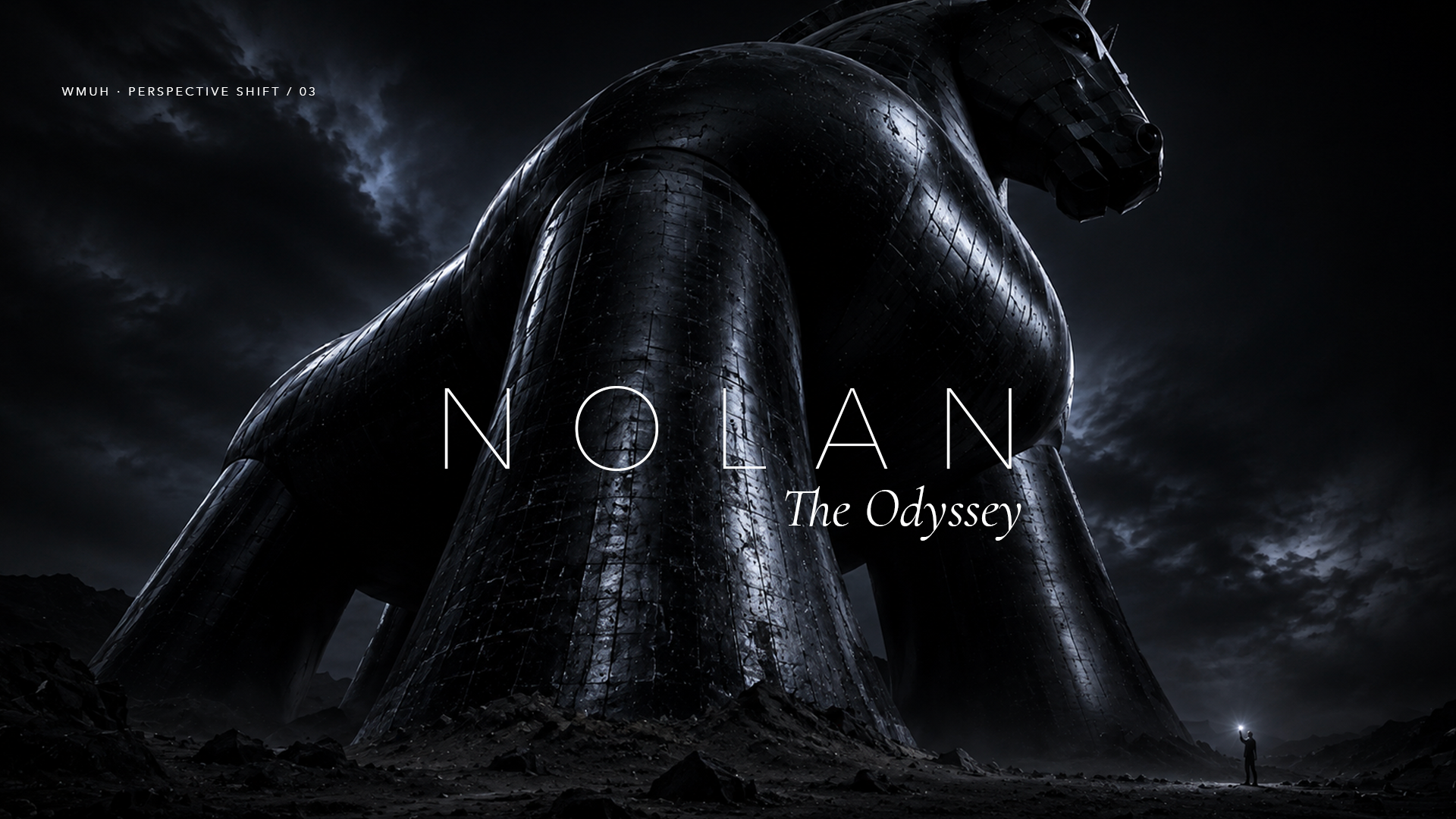
Homer hasn't changed in 2,700 years. We have. And that may be exactly why a story we think we know can suddenly tell us something new about ourselves.
I went into Christopher Nolan's The Odyssey expecting to see his interpretation of one of the oldest stories in Western culture.
I came out thinking about something else entirely: how much a story can change without changing a single word.
Homer hasn't changed. Odysseus hasn't changed. Troy hasn't changed. The Trojan Horse hasn't changed.
We have.
And watching Nolan's film, I became fascinated by what happens when culture moves far enough that it allows us to look back at something familiar and ask a different question.
The Trojan Horse is a good place to start.
For centuries, it has endured in our collective imagination as one of the great symbols of strategic ingenuity. Odysseus succeeds where force has failed. He thinks differently. The Greeks enter Troy. The war is won.
Even today, we use "Trojan horse" to describe the act of getting inside a system by disguising one's true intention.
Nolan doesn't erase that interpretation.
He shifts our perspective on it.
In his Odyssey, Troy is not simply the victory that precedes Odysseus's journey home. The film gives the fall of the city far greater weight, and with it, the consequences of the way Odysseus chose to win.
Suddenly, the interesting question is no longer simply:
How did Odysseus win Troy?
It becomes:
What did Odysseus change in the world by winning that way?
That is a very different question.
The Horse can still be understood as an extraordinary act of intelligence. But it can also be seen as the moment deception crosses a line. Something presented as an offering conceals an army. Trust itself becomes a vulnerability. A convention that made human relationships possible becomes something that can be exploited.
The innovation wins the war.
But what does it leave behind?
Nolan appears to make that ambiguity central to Odysseus's journey. His hero is not simply trying to return from the war he has won. He is also carrying the consequences of what he did to win it.
That reading isn't mine alone. Writing in The New Yorker, Richard Brody describes the Trojan Horse as "the crux of the story" in Nolan's adaptation, arguing that the deception and its consequences become central to the character Nolan constructs around Odysseus.
I find that shift fascinating because it changes the meaning of the journey home.
Odysseus may be trying to return to Ithaca, but he cannot simply return to the world that existed before Troy. He has participated in changing it. His intelligence solved one problem and, perhaps, created another.
There is something profoundly contemporary in that idea.
Not because Homer somehow predicted our world. And not because the Trojan Horse should become an easy metaphor for AI, social media, misinformation or any other contemporary anxiety.
That would be too convenient.
What feels contemporary is the question underneath it:
What happens when our ability to do something evolves faster than our ability to understand what doing it will change?
We tend to celebrate innovation at the moment of possibility. A new capability appears. Something previously impossible becomes possible. The immediate question is what we can do with it.
The harder question often comes later: what have we changed by doing it?
And this is where Nolan's relationship with Homer becomes more interesting to me than whether his adaptation is faithful.
Classicist Emily Hauser has challenged precisely this aspect of the film, arguing in The Guardian that Nolan's sensitive, repentant Odysseus is a distinctly modern construction, very different from the hero Homer gave us.
I understand the criticism.
But I wonder whether that displacement is precisely where the creative act begins.
Nolan isn't standing in ancient Greece. He cannot read The Odyssey as Homer's audience did. Neither can I. Neither can any of us.
He is looking back 2,700 years from a culture shaped by everything that has happened since. By our relationship with war, power, manipulation, trauma, responsibility, family, trust and technological change.
The text hasn't moved.
The culture looking at it has.
And perhaps that is why the same story can reveal something different.
Culture doesn't simply create new things around us. It changes the meaning of things that were already there. Every generation inherits the same past with a different set of questions, anxieties and possibilities.
Which means that returning to the past doesn't necessarily mean looking backwards.
Sometimes it is another way of looking at the present.
And that is where The Odyssey becomes, for me, a fascinating case of innovation.
We have become accustomed to defining innovation through novelty: new technologies, new tools, new formats, new experiences. The assumption is almost directional. Innovation points forward.
Nolan went back 2,700 years.
He took a story almost impossibly familiar and treated its meaning as unfinished.
That distinction matters.
Because innovation doesn't necessarily begin with something nobody has seen before.
Sometimes it begins when we stop accepting that what everybody already sees is all there is to see.
That, to me, is where consensus becomes interesting.
Consensus isn't necessarily wrong. Familiar interpretations aren't necessarily outdated. And challenging them for the sake of being different isn't innovation.
The problem begins when familiarity becomes certainty. When an inherited interpretation feels so settled that we stop asking whether another reading might be possible.
Nolan does something else.
He returns to familiar material and allows the present to destabilise it.
And interestingly, his approach to making the film seems to follow a similar instinct.
At a moment when cinema can manufacture almost any image, Nolan repeatedly chose physical constraints: real locations, IMAX cameras, practical environments and situations that could not be completely controlled in advance. Speaking about filming at sea, Nolan described the process as almost documentary-like: "we shot like it was a documentary", allowing the physical world to introduce things the production could not entirely predict.
Again, the innovation doesn't necessarily come from adding another layer of possibility.
It comes from changing the conditions through which something is seen.
That may also help explain why the film has generated disagreement. Some see a powerful contemporary reinterpretation. Others see Nolan imposing himself too heavily on Homer.
But perhaps a genuine reinterpretation should create that tension.
If everybody sees exactly what they expected to see, nothing has really shifted.
And this is where Nolan interests me beyond The Odyssey itself.
I see in him one of those rare creators willing to move beyond consensus before there is any guarantee that people will follow. Not because consensus is necessarily wrong, but because he seems to understand that once an interpretation becomes universally familiar, it can also become invisible.
That requires more than originality. It requires an ability to read culture: to sense that the questions surrounding an object have changed before a new answer has become obvious.
And inevitably, that creates friction.
Nolan disrupts because he shifts the perspective. He challenges because he refuses to inherit the question. And that, to me, is where innovation actually begins.
Not in novelty for its own sake.
Not in provocation for its own sake.
But in seeing that something everybody thinks they understand might need to be looked at again.
And this is what I keep coming back to after The Odyssey.
We often talk about culture as though it were the new material constantly appearing around us. New behaviours, new aesthetics, new technologies, new language.
But culture also changes the way we look backwards.
It changes the questions we ask of what came before us. And when those questions change, the past can begin to mean something different.
Not because history has changed.
Because we have.
Perhaps that is one of the most powerful forms of creative exploration: not constantly searching for something nobody has ever seen before, but having the courage to look again at something everybody thinks they already understand.
To question the inherited reading. To move beyond the obvious. To allow today's culture to reveal something yesterday's culture couldn't see in quite the same way.
Innovation doesn't come from rejecting the past. It comes from refusing to believe that our understanding of it is finished.
Nolan went back to Homer.
And somehow, he came back with 2026.
Sources: Richard Brody, The New Yorker, July 2026 · Emily Hauser, The Guardian, July 15, 2026 · Christopher Nolan interview, Los Angeles Times, July 7, 2026
Perspective Shift #03 · What Makes Us Human